Welcome to visitShanghai Chinon medical Model & Equipment Manufacturing Co., LTD

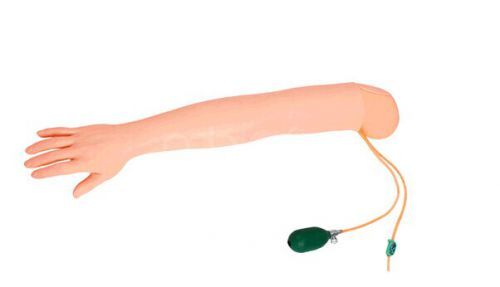
Two of the most common needle procedures in hospital care are also two of the most frequently performed incorrectly: arterial blood sampling and intramuscular injection. Both fail for the same reason — the learner has the theory but has never felt the resistance of a vessel wall or the depth of a muscle belly. The HS5 is an arm trainer built for those two procedures, so a student can practise the angle and the feel before touching a patient.
This guide sets out what to teach on the model, in what order, and what the model cannot tell the student.
| Procedure | Skill being trained | Common learner error |
|---|---|---|
| Arterial puncture | Locating the artery, needle angle, aspiration technique | Angle too shallow, probe instead of puncture |
| Intramuscular injection | Site selection, needle depth, aspiration and withdrawal | Injecting too high or too lateral on the arm |
| Site marking | Identifying landmarks before needle contact | Skipping palpation entirely |
| Hand hygiene and asepsis | Full procedure sequence | Starting with the needle, not the prep |
The most common failure in both procedures is not needle technique — it is landmark identification. A student who cannot find the artery by palpation will not find it with a needle.
Run the session in this order:
WHO guidance on drawing blood is explicit that the procedure is only as safe as its preparation and disposal steps, not only its puncture [1]. Assess the whole sequence, not only the moment of needle entry.
The model gives the learner a realistic arm contour and a target vessel, which is enough to correct gross errors: approaching at 45 degrees instead of a shallower arterial angle, or aiming too distal. It cannot teach the subtle feedback of a vessel that rolls, a patient who moves, or a haematoma forming under the skin.
The honest framing for students is that the model teaches the sequence and the geometry. Real tissue response comes later, under supervision. Simulation research consistently shows that physical models improve procedural learning but do not replace supervised clinical practice [2].
Do not grade on "did the needle go in". Grade on observable behaviours:
A checklist of five behaviours is enough for a formative assessment and far more reliable than a global impression.
Quotation and specification. Current pricing, spare skin and vessel sets for the HS5 are available from chinonmed@adaanatomy.com.
Q1. What procedures does the HS5 support? Arterial puncture for blood sampling and intramuscular injection, practised on a lifelike arm.
Q2. Is it a full-body manikin? No. It is an arm trainer focused on injection and puncture skills.
Q3. Can students practise on it without supervision? It is suitable for supervised practice and self-directed repetition of the sequence, but clinical competency still requires supervised patient contact.
Q4. What wears out first? The puncture sites and vessel tubing. Ask the supplier for replacement parts and their cost before purchase.
Q5. Is it suitable for phlebotomy training too? The model is specified for arterial puncture and IM injection. Confirm with the supplier whether venous access is also supported before designing a phlebotomy station around it.
Q6. How many students can one arm serve? Two to three per station, rotating roles of operator and observer, keeps the queue short and the assessment honest.
Product page: Teaching Arterial Puncture and IM Injection on the HS5 Arm Trainer — specification, packing data and a quotation request form.
For a quotation on the HS5 with replacement vessels and skin pads, write to chinonmed@adaanatomy.com with your annual student intake.
|
NEXT:BIX-J2A Neonate Intubation Head: Building a Drill That Survives the NICU
LAST:NULL |
Return list |
